Shoes for - Anyone on Their Feet 10 Hours a Day
A consultant from a hospital in central Delhi has been buying shoes from us for about eleven years. She works twelve-hour days, most of them standing, on hard flooring. A few years ago she told us something that has stuck with us since:
"Everyone tells me to buy comfortable shoes. Nobody can tell me what that means."
She's right, and the word has been made almost useless by marketing. Every shoe sold in India claims to be comfortable. Most of them are comfortable for about forty minutes.
Standing for ten hours is a different engineering problem from walking for one. Here is what actually matters, roughly in order of how much difference it makes.
1. Fit, Not Cushioning
Almost everyone reaches for cushioning first. It's the wrong first move.
If a shoe is slightly too large, your foot slides forward a few millimetres with every step and every weight shift. Over ten hours that's thousands of micro-movements, each one creating friction and forcing the small muscles of your foot to grip in order to stabilise. That's what produces the specific bone-deep ache people describe at the end of a long shift — not impact, but constant low-grade muscular effort.
A perfectly fitted shoe with modest cushioning will outperform an over-cushioned shoe that's half a size too big. Every time.
Get the fit right first. Our shoe size guide covers how to measure properly, but the short version for long-shift wear: fit to your larger foot, measure in the evening, and if a shoe pinches across the ball while your toes have room, you need a wider last — not a longer shoe.
2. Heel-to-Toe Drop
Completely flat is not ideal. Neither is high.
A dead-flat sole puts sustained load on the Achilles and the plantar fascia, which is why ballerinas and flat sliders often feel worse after eight hours than a shoe with a slight rise. A high heel does the opposite and pushes everything onto the forefoot.
The sweet spot for standing work is a small, consistent rise — roughly 15 to 25mm at the heel. Most well-made leather loafers and formals sit naturally in that range. For women, a low block heel is genuinely better for a long day than a flat, which surprises people. Melly Leather Buckle Block Heels sit in that range and adjust at the strap.
3. The Footbed Has to Be Leather or Moulded — Not Flat Foam
Soft foam feels wonderful in the shop and compresses to nothing within six weeks. If your shoes felt great for the first month and awful afterwards, this is why.
What lasts:
● Leather footbeds — mould to your foot over the first few weeks and then hold that shape for years
● Moulded EVA or PU — built with arch contour rather than relying on flat padding
What doesn't: a flat pad of soft foam glued to a flat board, which is what most inexpensive "cushioned" footwear is.
4. Rotation — The Thing Nobody Wants to Hear
One pair worn ten hours a day, five days a week, will not stay comfortable no matter how good it is.
A shoe absorbs a significant amount of moisture across a long day. It needs roughly 24 hours to release it. Worn again the next morning while still damp, the footbed compresses faster, the leather softens permanently, and the structure that was supporting you stops supporting you.
Two pairs alternated will each last more than twice as long as one pair worn daily. This is the cheapest comfort upgrade available and almost nobody does it.
For Men: What Works Over Ten Hours
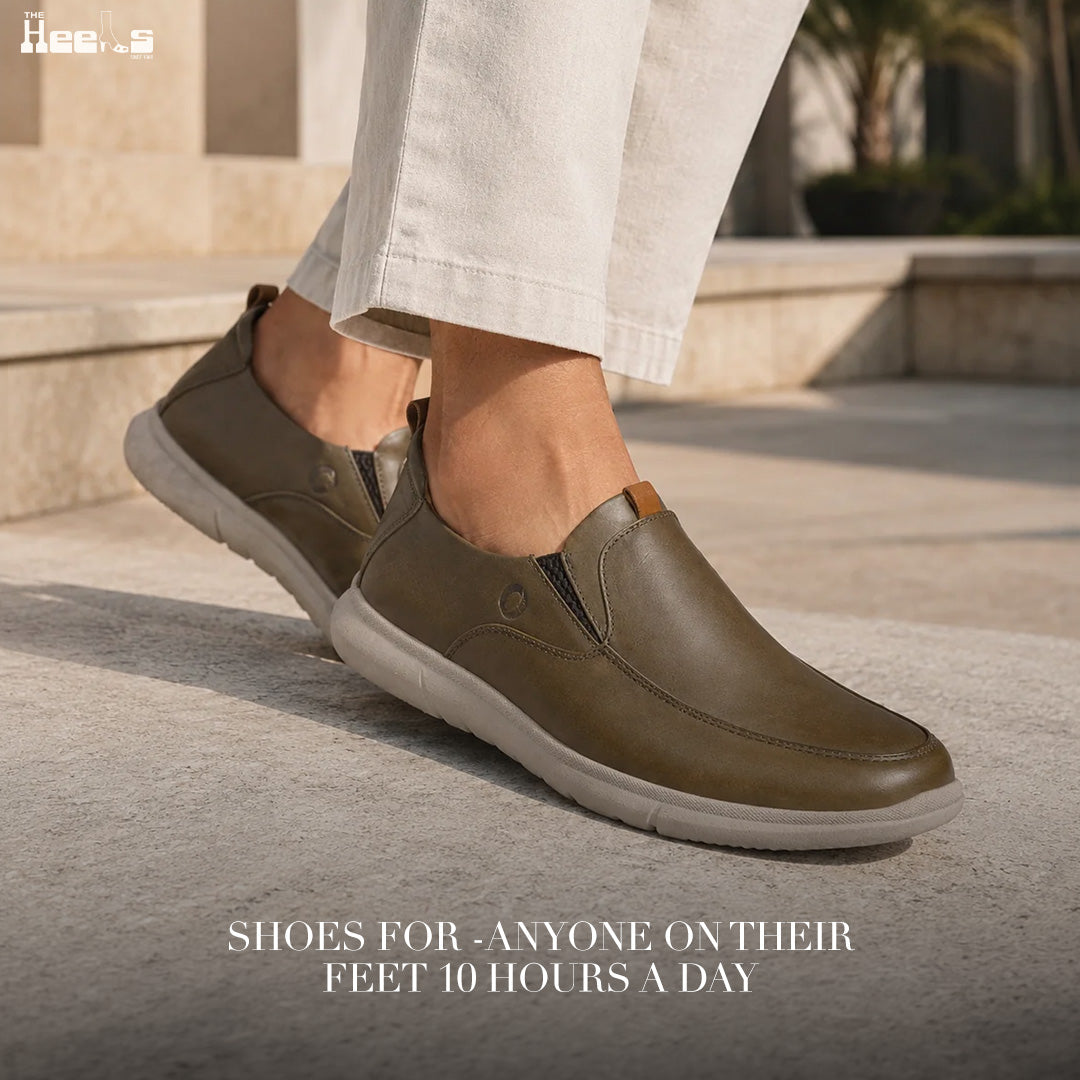
If you wear formals to work. A cushioned leather loafer is the most comfortable formal option available — no laces to loosen and retighten as your foot swells, and a footbed that adapts. James Cushioned Leather Loafers are the pair we recommend most often to professionals on their feet; Andrew Comfort Daily Leather Loafers are the step up in leather quality.
If you need a lace-up. Court, formal meetings, strict dress codes. Jonah Leather Formal Oxfords hold structure across a long day. One thing worth knowing: relace them at lunchtime. Your feet will have swollen and the lacing that was right at 9 AM is now cutting across your instep.
If your dress code has any flexibility. A leather sneaker or slip-on with a proper sole is meaningfully more comfortable than any formal. Hunter Zero Gravity Sneakers and Zero Gravity Noah Lace-up Sneakers are built for exactly this — enough structure to read as smart, enough cushioning for a full shift.
If you're on your feet in a warm environment. Sebastian Leather Moccasins — soft construction, no rigid seams pressing on a swollen foot.
For Women: What Works Over Ten Hours
The most reliable option is a cushioned leather loafer. It covers most professional dress codes, holds the foot properly, and doesn't demand the compromises a heel or a flat does. Lexi Cushioned Leather Loafers and Mikela Classic Leather Loafers both work under formal trousers and under a saree.
If you prefer a ballerina, choose one with a defined footbed and a back that holds — not a thin unstructured slipper. Donna Leather Buckle Ballerinas adjust at the strap, which matters as feet swell through the day.
If your workplace expects a heel, go block, go low, and go adjustable. A 25mm block heel with a strap will carry you through a day that a 70mm stiletto will not.
For the commute. Change at the office. Wear Bianca Leather Slip On Mules or a cushioned slider door-to-desk and keep the work pair at work. It sounds fussy; it removes about two hours of wear from your good shoes every single day.

By Profession
|
You Are a… |
What Matters Most |
Look For |
|
Doctor / hospital staff |
Hard flooring, long shifts, easy cleaning |
Closed leather, wipeable, cushioned footbed, slip-on for speed |
|
Lawyer |
Strict formality, long standing periods in court |
Structured lace-up or formal loafer, leather footbed, relace midday |
|
Teacher / academic |
Standing plus constant short walking |
Slight heel rise, flexible forefoot, breathable leather |
|
Retail / hospitality |
Ten-plus hours, polished floors |
Textured sole for grip, maximum cushioning, two-pair rotation essential |
|
Government / corporate office |
Formality plus long commute |
Comfortable formal at work, change-at-desk pair for transit |
|
Business owner / on site |
Unpredictable — desk, floor, car, site |
Leather sneaker or structured slip-on that reads smart |
If Your Feet Already Hurt
Some honesty here: footwear solves footwear problems. It doesn't solve medical ones.
If you have persistent heel pain first thing in the morning, numbness or tingling, visible swelling that doesn't settle overnight, or pain that has been getting worse over months — see a podiatrist or an orthopaedic specialist. Plantar fasciitis, fallen arches and neuromas are treatable conditions, and a better shoe is part of managing them rather than a substitute for treatment.
What we can do is make sure the shoe isn't making it worse, and that it accommodates any orthotic you've been prescribed. Bring the orthotic in with you — it changes which styles will work, and it's much easier to fit around it than to discover the problem afterwards.
[IMAGE 4 — In-store fitting for a professional customer, hands and shoe, warm shop light. ALT: Professional shoe fitting for long working hours at The Heels, Connaught Place]
Come and Stand in Them
Comfort over ten hours is impossible to judge in thirty seconds. When you come to the Connaught Place shop, stand in the shoe. Walk the length of the floor. Do it late in the day when your feet are already swollen. If a member of our staff tells you a pair is fine and it doesn't feel right to you, believe your feet.
Many of our regular customers are doctors, lawyers and officials working nearby — the shop has been at CP since 1980 and a good part of what we know about long-shift footwear came from them telling us what failed.
If you can't get to CP, Heels On Wheels brings a shortlist to your home or office — useful if you finish at 9 PM and every shop is closed.
Common Questions
What are the best shoes for standing all day in India?
A correctly fitted leather shoe with a moulded or leather footbed and a small heel rise of 15–25mm. Fit matters more than padding, and rotating two pairs matters more than either.
Are flat shoes bad for standing all day?
Completely flat soles put sustained strain on the Achilles and plantar fascia. A small heel rise is generally more comfortable over a long shift than a dead-flat sole — which is why many people find a low block heel easier than a ballerina.
Why do my feet hurt even in cushioned shoes?
Usually fit. A shoe that's slightly too large lets the foot slide, forcing the small stabilising muscles to work continuously. That produces a deep ache that no amount of cushioning fixes. It can also be foam that has compressed and stopped supporting.
How often should I replace work shoes worn daily?
Worn every day, expect 8–12 months before the footbed and structure give out. Rotated with a second pair, each will comfortably last two to three years.
Should I use insoles for standing all day?
An insole can help if the shoe is otherwise well fitted. It can't rescue a shoe that's the wrong size — adding an insole to a too-large shoe just reduces the internal volume unevenly. Fix the fit first.
Are loafers good for long working hours?
Yes — often better than lace-ups, because there's no lacing to cut in as feet swell. The requirement is that they fit snugly at the heel, since nothing else holds them on.